By Racquel Henry, PhD
In an unknown location in New Salem, Illinois, Abraham Lincoln responded to an editorial printed in the Sangamo Journal of June 11, 1836. The writer had called out all those candidates planning on representing Sangamon County in the Illinois legislature. Signing the letter “Many Voters,” the anonymous writer had said, “I think the times demand from them a declaration of their political doctrines at as early a period as possible. Then the people will be better prepared to judge of their qualification and fitness to serve.”
Lincoln served his first term as a Whig in the House of Representatives in Illinois’s Legislature in 1834. He was running for re-election. On June 13th, he submitted his circular/letter in response to “Many Voters.” Immediately, Lincoln addressed who should vote in Illinois elections, concluding the privilege belonged to all whites “who pay taxes or bear arms.” He mentions not “excluding females.” Lincoln presents, for Sangamon constituents, how proceeds from public lands must be allocated for building needed state infrastructure. If the federal government awards Illinois her fair share of such monies, “our state … can dig canals and construct railroads, without borrowing … and paying interest.”
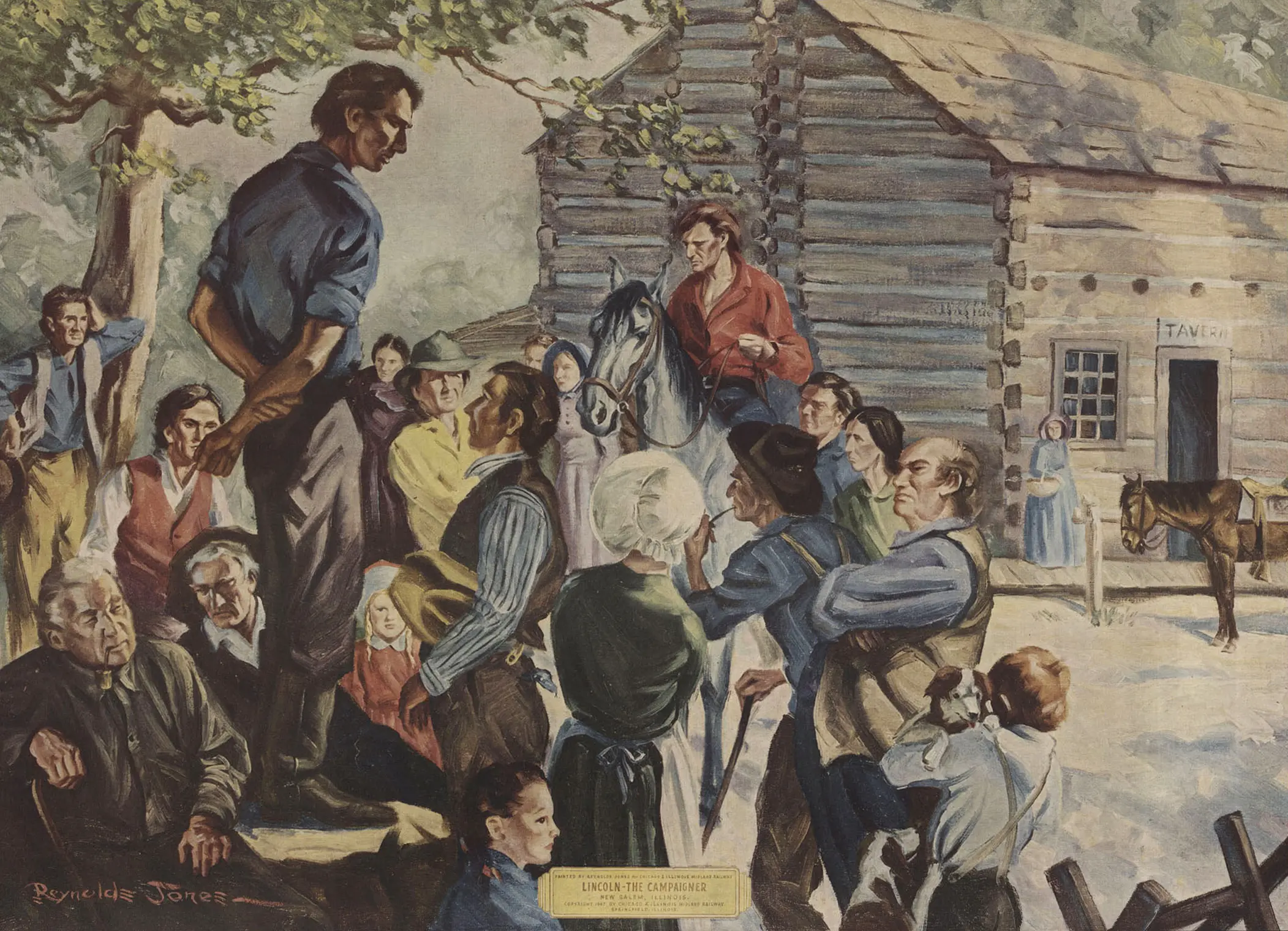 An artist’s conception of young Lincoln on the campaign trail.
In 1836, it is Lincoln’s Whig friend and editor of the Sangamo Journal, Simeon Francis, that used Martin Van Buren’s vote for Black suffrage to berate Democrats, rehashing old news. Before his Vice Presidency, then Senator Van Buren, voted that free African Americans should have suffrage during a New York political convention in 1821. Even though African Americans were given enfranchisement, it came with a $250 property requirement.
Van Buren’s presidential race and free African American suffrage was a point of contention in Illinois that year. In the Northwest, African American disenfranchisement was not uncommon. Lincoln side stepped announcing his Tuesday January 5, 1836 vote, against Black suffrage in the circular. The General Assembly resolved “[t]hat the elective franchise should be kept pure from contamination by the admission of colored votes.” White male suffrage was already part of the 1818 state constitution.
 Lincoln on who should be allowed to vote.
It is believed that Lincoln pulled women into his response for several reasons. Lincoln did participate in debating and literary societies where he spoke on women’s suffrage. He also might have used women’s suffrage to avoid talking directly about voting for African Americans, unlike his rivals Ninian Edwards and Andrew McCormick. In their circular responses they directly addressed the dislike of African American male suffrage. It was only prudent politics to curry favor with women to use the power of female suasion. Women could persuade male companions and relatives to vote for him. Also, Lincoln is more focused on economic and infrastructure issues in the 1830s. The only way to tackle these issues was to win the race.
He knew Illinois women did not have suffrage and lost any rights to their own property after matrimony, unless a “separate estate/trust” was created to circumvent the doctrine of coverture. Without a trust, coverture allowed husbands in most states to take ownership of their wife’s property. Only the wealthy were afforded such estate planning.
In 1837, Lincoln voiced his opinion concerning African American slavery and abolitionism with a protest resolution. The Illinois General Assembly was against allowing abolitionism in the state. But Abraham Lincoln and fellow whig legislator and attorney Dan Stone protested the language the assembly used. Both agreed that even though domestic bondage was constitutionally acceptable, “the institution of slavery is founded on both injustice and bad policy; but that the promulgation of abolition doctrine tends to rather increase than to abate its evils.” On March 3, 1837, the legislature did not respond to Lincoln’s and Stone’s protest or vote to change the language.
Here, Lincoln rails against the human rights injustice of slavery that prevented true democracy in America. Even though he took this stance, Lincoln is in nineteenth century America. He knew pressing the injustices of slavery in the prairie state would not win constituents. So, years later, during his U.S. Senate race against Stephen Douglas, on October 13, 1858, in Quincy, during one of their seven debates across Illinois, Lincoln held publicly to his racial bias. “I am not in favor of bringing about in any way the social and political equality of the white and black races … I am not nor ever have been in favor of making voters or jurors of negroes,” Lincoln said. Douglas called him an abolitionist but after this debate, he emerged as an anti-civil rights candidate in matters concerning African Americans.
President Lincoln did not consider civil rights for African Americans until his final speech, on April 11, 1865, when he stated, “It is also unsatisfactory to some that the elective franchise is not given to the colored man. I would myself prefer that it were now conferred on the very intelligent, and on those who serve our cause as soldiers.” He was assassinated just three days later. America would never know what measures Lincoln would have taken to make African American suffrage possible.
Beyond his stance on African American suffrage and slavery, Lincoln and half his political rivals also laid out their concerns about public land proceeds and federal refunds in the Sangamo Journal editorial. He broached public land sale proceeds long before his re-election. January 10, 1835, he introduced a resolution that would allow the state of Illinois to receive 20 percent annually of the amount paid to the U.S. Treasury for lands sold in Illinois. House members tabled the resolution, but Lincoln remained focused on what these funds meant to his constituents. In Illinois, infrastructure improvements politically held sway because commerce’s progress depended on such funding. If the proceeds materialized, projects like the Illinois and Michigan Canal, the Northern Cross Railroad, and the Des Plaines River extension to the Saganashkee Slough could be realized.
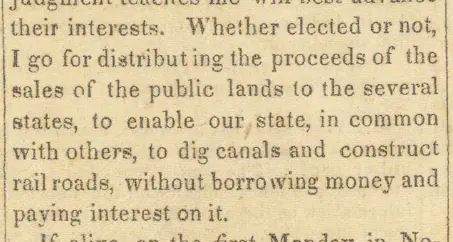 Lincoln on selling public land to pay for infrastructure
In 1836, the federal government treasury surplus was distributed. U.S. Representative Henry Clay and U.S. Senator John C. Calhoun worked together crafting a bill that President Andrew Jackson approved and signed into law on June 23, 1836. It was the Deposit/Distribution Act. Illinois received $477,919 in 1837 starting in January and ending in October. Lincoln’s desires materialized as infrastructure spread in spits and spurts throughout the antebellum period in Illinois.
The Whig newspaper, the Sangamo Journal, brought life and color to the 1836 race for the legislature, but hardly did Lincoln know this was only the beginning for him. At age 27, he did not understand his charm, storytelling, and popularity among constituents would lead to a presidential run by 1860. The 1830s, ‘40s and ‘50s built character in this future president. It helped prepare him for the bumpy ride of leadership in the Executive Mansion and enabled him to lead a country through Civil War and slavery’s end. It is Abraham Lincoln’s great legacy that has created many things Americans still enjoy.
Henry is the ALPLM's 19th Century Historian.