By Dr. Racquel Henry
ALPLM 19th Century Historian
On May 30, 1922, Dr. Robert Russa Moton, president of the Tuskegee Institute, delivered the keynote address at the Lincoln Memorial dedication. He spoke first, after the ceremony was opened by the Rev. Wallace Radcliffe, pastor of the New York Avenue Presbyterian Church. The event also featured Chief Justice William H. Taft, chairman of the Lincoln Memorial Commission, who presented the monument to the nation, and President Warren G. Harding, who followed this with an oration. To Harding and the commission, the event represented a triumphant end to Republican Party efforts to build the monument to America’s greatest hero, work that had started fifty-seven years earlier. The monument carried with it the weight of what the sixteenth president symbolized to memorial commission members, whites and African Americans in twentieth century America.
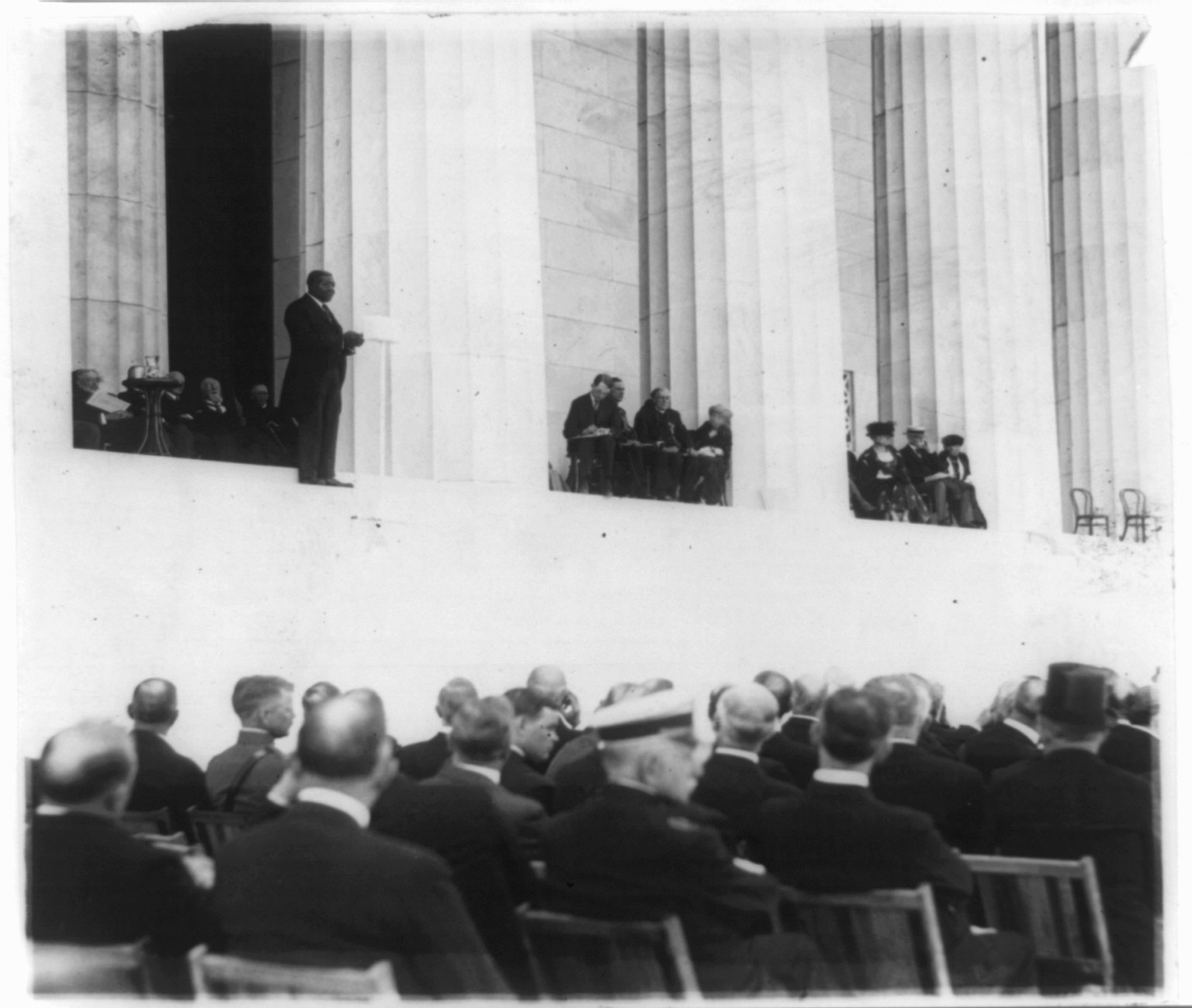 Moton speaking at the Lincoln Memorial dedication. (Library of Congress)
The commission and President Harding intended the ceremony to promote unification of North and South, smoothing over the wounds from the Civil War and sidelining Lincoln the emancipator. But the desires of the commission failed. Reality eclipsed their plans of unification. In 1922, the combination of African Americans returning from World War I and a huge population of them migrating from the South to urban centers, sparked racial violence in America. African Americans refused to return to the pre-war racial order, so, white citizens felt their own interests threatened and attacked them.
Despite the racial unrest, for African Americans the Lincoln Memorial still represented their emancipator, equality, and justice. However, the ceremony reflected America’s racial boundaries. As Chicago Defender reporter J. Le Count Chestnut stated, “The venomous snake of segregation reared its head at this dedication.” Area five, roped off as the “colored” section at the direction of Lieutenant Colonel Sherrill of parks and grounds under Harding, set the tone. Prominent African American doctors and lawyers were treated abrasively by Marines serving as ushers. Reporter Chestnut refers to the seating as “Bloc d’ Afrique” – translated block of Africans – and condemned those who went along with the segregated seating, saying, “Shame forever on those apologies who sat in that sector of squalid conscience…”
Beyond the insult of segregated seating in America’s capital, the late selection of Moton as spokesman for the race occurred because the committee realized they had forgotten to include an African American speaker for the occasion. The commission believed Moton a safe selection. He had the same philosophy of accommodationism as Booker T. Washington, his predecessor at Tuskegee. He had proven himself the perfect intermediary for President Woodrow Wilson, especially when he went to France at the close of World War I to ask returning African American soldiers not to expect the same equality they had experienced there. His efforts proved problematic among African Americans. Many considered this an insult to the race, even though Moton’s intent was to diplomatically ease a difficult situation.
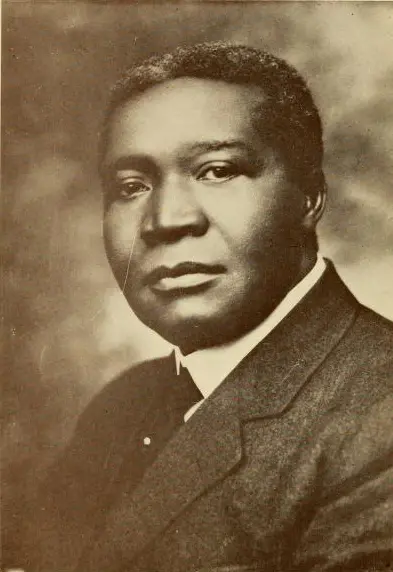 Moton around 1922 (Wikimedia Commons)
Many believed his conservative views – proven with an incident concerning his wife, Jennie Dee Booth Moton, being ejected from a Pullman sleeper train in Alabama in 1916, where Moton held his tongue and did not publicly protest her treatment or condemn segregation – meant he would not speak up for his race. With this incident, Moton appeared to be as his critics declared. He concealed his thoughts about segregation, Jim Crow, and inequality for what he believed a greater good, carefully selecting when to protest such treatment.
His speech at the memorial dedication was going to be the moment he publicly dropped accommodationism to call out the nation’s flaws in race relations. Moton’s original speech used language similar to Abraham Lincoln’s “House Divided” speech given in 1858 at the Springfield, Illinois legislature and the Gettysburg Address. Moton’s radical version included these words:
No more can the nation endure half privileged and half repressed; half educated and half uneducated; half protected, and half unprotected; half prosperous and half in discontent; yes, half free and half yet in bondage.
My fellow citizens, in the great name which we honor here today, I say unto you that this memorial which we erect in token of our veneration is but a hollow mockery, a symbol of hypocrisy, unless we together can make real in our national life, in every state and in every section, the things for which he died.
The memorial commission received his speech two weeks before the dedication ceremonies. Chairman Taft requested Moton cut five hundred words. Taft suggested Moton think more in terms of unity and symmetry and make it less of an appeal to strike down American hypocrisy and racism. He also said, “I am sure you wish to avoid any insinuation of attempt to make the occasion one for propaganda.”
Dr. Moton chose to make the requested changes, dropping most of the radical segments, acquiescing to the memorial commission’s wishes. The Chicago Defender’s editor, Robert Abbott, took up for Moton when he said, “he may have shown those running the affair that they might insult but never degrade brains. Dr. Moton made a speech to which nobody can object.” Still, Abbott called on African Americans to boycott the memorial until it could be better dedicated. Taft and Harding, Abbott felt, had dishonored Lincoln’s memory by sidestepping emancipation and his true legacy. Moton did not break stride. Known for focusing on the bigger picture, he made the changes to his speech and remained the dedication’s keynote speaker because he believed access to major political figures could help him continue his quiet work of making things better for African Americans. To him, this work was more important than the insult of being forced to alter his speech.
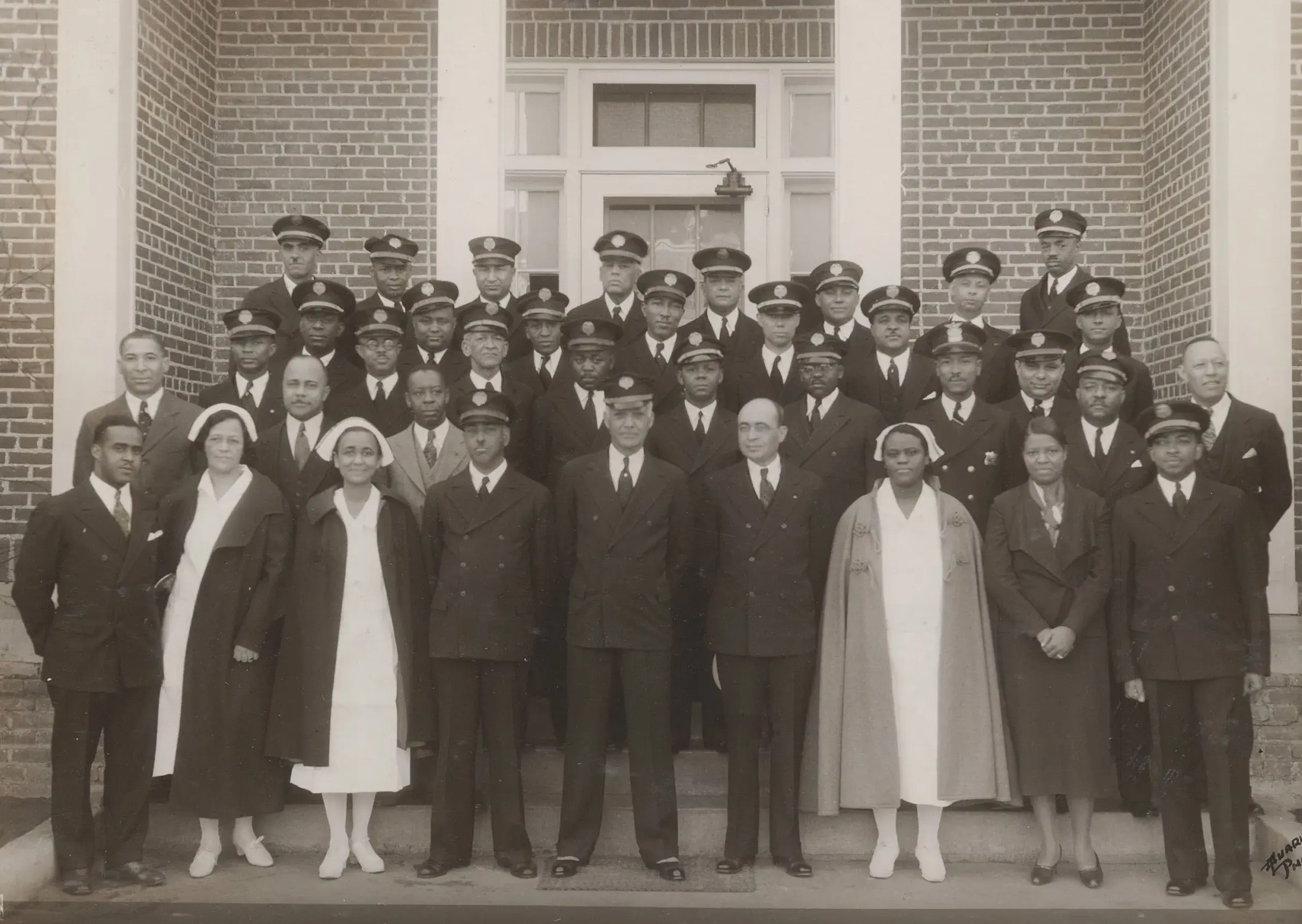
Moton’s efforts in Washington, D.C., meant when he called upon President Warren G. Harding in 1923 to ensure that a veteran’s hospital for African American soldiers in Tuskegee, Alabama would be staffed by African American doctors and nurses, the president made it happen. Moton’s determination to right injustices clearly reflected parts of Lincoln’s efforts as president. Lincoln learned while in Washington, that all Americas deserve equality and justice, He was assassinated because of that belief.
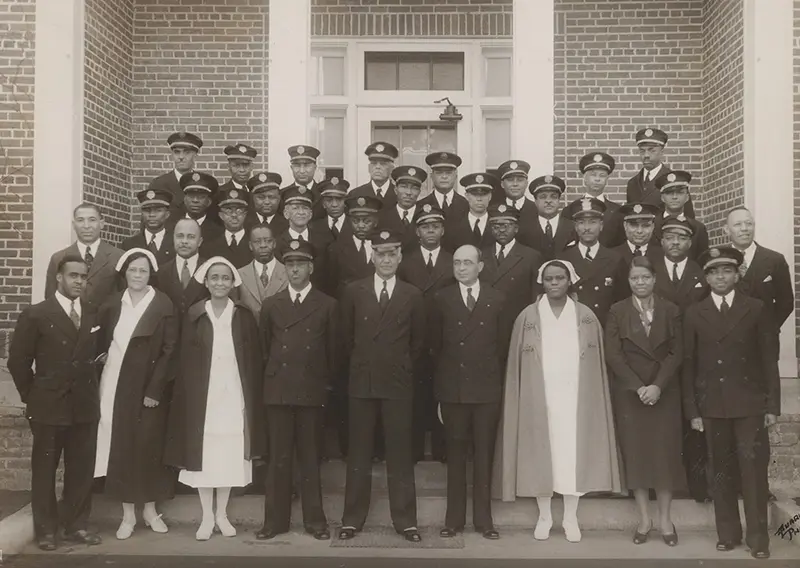 The staff of the Tuskegee veterans home in 1933.
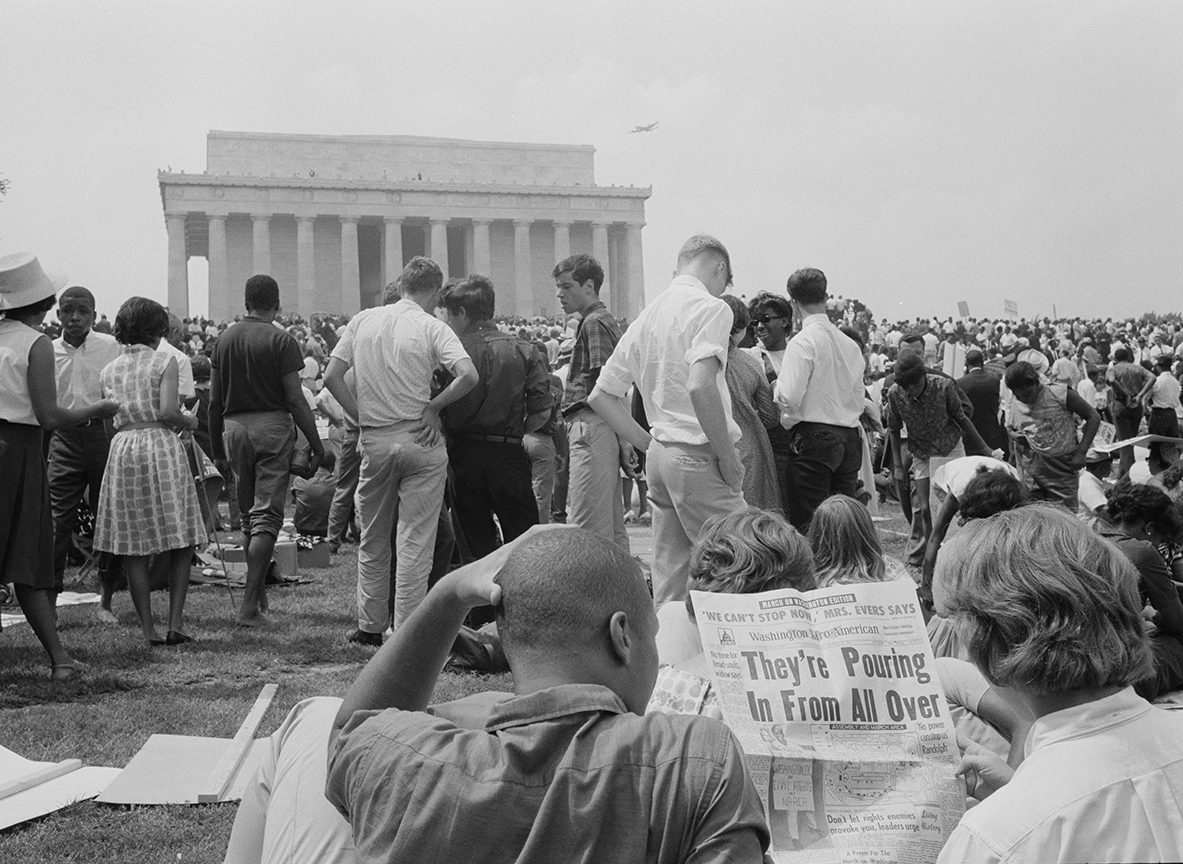
Though the Lincoln Memorial ceremony on May 30, 1922, was fraught with racial difficulties, things changed over time. Harding, Taft, and Moton never could have envisioned that Americans would choose this site as a place for protests of social and political ills, seeking remedies from the federal government.
So, President Lincoln will and his memorial always be associated with the political and social work this nation has before it.
 Protestors at the 1963 civil rights march on Washington. (Library of Congress)
Note: See footage of the dedication here.
Staff at the Tuskegee veterans home
×
Moton Speaking at the Dedication

×
1963 March on Washington
×