1.1 Introduction and Overview
Introduction
The State of Illinois is home to one of the largest immigrant populations in the United States, with nearly 1.9 million immigrants contributing to the state's vibrant cultural and economic landscape. Among them, nearly 1 million residents speak languages other than English at home and report speaking English less than "very well." As this linguistically diverse population continues to grow, Illinois recognizes that all residents—regardless of English proficiency—have a right to equitable access to government services.
This Language Access Plan outlines the Abraham Lincoln Presidential Library and Museum’s [ALPLM] five-year plan for language access implementation, a timeline selected to achieve greater alignment with the Illinois Language Equity and Access Act. Section 1 of the Language Access Plan sets the stage for the plan by providing an overview of ALPLM and establishing the purpose, goals, and guiding principles that anchor the Language Access Plan. The sections that follow, Sections 2 to 7, address specific areas of language access implementation. Each area of implementation is addressed in two distinct parts, which include:
1. Overview of Standard (or Implementation Area): A brief description of the standard based on federal guidance and the Language Equity and Access Act.
2. Current ALPLM Systems and Practices: A description of ALPLM’s current practices, existing infrastructure, and/or progress to date in relation to the standard Implementation Goals and a 5-Year Action Plan is provided to support agency implementation:
Implementation Goals: provides an overview of the overarching goals ALPLM will pursue to meet compliance objectives 5-Year Action Plan: a list of detailed time-bound action items to be completed by ALPLM in three phases over an implementation period of five years:
a. Phase 0 (Year 0)
b. Phase I (Year 1)
c. Phase II (Years 2 and 3)
d. Phase III (Years 4 and 5)
i. The timeframe for a phase is subject to modification by ALPLM.
ALPLM’s Role
The Abraham Lincoln Presidential Library and Museum inspires civic engagement through the diverse lens of Illinois history and sharing with the world the life and legacy of Abraham Lincoln.
The ALPLM website https://presidentlincoln.illinois.gov
The ALPLM Language Access Coordinator Christen Stanley christen.stanley@illinois.gov 217-558-8893
ALPLM’s Divisions, Offices and Functions
The ALPLM is an independent State Agency within the Executive Branch of State government created by the ALPLM Act (20 ILCS 3475). The Agency complex is in Springfield, Illinois, and consists of the ALPLM library, museum, Union Station, Union Square Park, and parking garage. The ALPLM is under the supervision and direction of an Executive Director and advised by the Abraham Lincoln Presidential Library and Museum Board of Trustees. The ALPLM is open all but three days each year to provide patrons, guests, researchers, students, and history enthusiasts with a memorable experience that will expand their world view.
1.2 Language Access Plan Legal Basis and Purpose
Purpose and Goals
This Language Access Plan aims to provide guidance to ALPLM staff and establish a roadmap to support meaningful access to the department’s services, programs, and opportunities for individuals with LEP. The Language Access Plan also seeks to align the department’s efforts and bring ALPLM into compliance with Illinoi’s Language Equity and Access Act (Public Act 103-0723), the Illinois Civil Rights Act of 2003, Title VI of the Civil Rights Act of 1964 and other applicable federal and state standards and guidelines.
Authority
As a recipient of federal financial assistance, Illinois is bound by Title VI of the Civil Rights Act of 1964 (Title VI), 42 U.S.C. §§ 2000d-2000d-7, and its implementing regulations, 45 C.F.R. Part 80, which prohibits discrimination based on race, color, or national origin (which includes Limited English Proficiency). Illinois is committed to advancing the goals of Title VI of the Civil Rights Act of 1964 in alignment with the State of Illinois’ Language Equity and Access Act (Public Act 103-0723).
Title VI of the Civil Rights Act of 1964
Title VI of the Civil Rights Act of 1964 (42 U.S.C. § 2000d) (Title VI) prohibits discrimination on the basis of race, color, or national origin in any program or activity receiving federal financial assistance. As a recipient of federal financial assistance, the [Department/Agency] is bound by Title VI of the Civil Rights Act of 1964 (Title VI), 42 U.S.C. §§ 2000d-2000d-7, and its implementing regulation, 45 C.F.R. Part 80, which prohibits discrimination based on race, color, or national origin (which includes Limited English Proficiency).
Illinois Civil Rights Act of 2003
The Illinois Civil Rights Act prohibits State, county, or local government in Illinois from excluding a person from participation in, denying a person the benefits of, or subjecting a person to discrimination under any program or activity on the grounds of that person’s race, color, national origin, or gender. Additionally, the Illinois Civil Rights Act prohibits using criteria or methods that have a discriminatory effect.
Illinois Human Rights Act (IHRA)
The Illinois Human Rights Act consolidates existing laws and administrative processes addressing civil rights in Illinois. IHRA prohibits discrimination in employment, housing, financial credit, and public accommodations because of race, color, sex, religion, ancestry, national origin, age, physical or mental disability, unfavorable military discharge, and marital status, as well as retaliation for opposing discrimination. IHRA established the Illinois Department of Human Rights (IDHR) and the Illinois Human Rights Commission (IHRC) as enforcing agencies (https://dhr.illinois.gov/about-us/directors-office/agency-overview-and-history.html).
Language Equity and Access Act
Signed into law by Governor Pritzker in 2024, the Language Equity and Access Act 2024 aims to ensure that all residents can access state information, programs, and services equitably, and that limited English proficiency does not prevent anyone from fully participating in civic life.(See Language Equity and Access Act, Public Act 103-0723, 103rd Gen. Assem. (Ill. 2024), https://www.ilga.gov/legislation/publicacts/fulltext.asp?Name=103-0723.) The Act aims to ensure all Illinois residents, including individuals with LEP, have meaningful and equitable access to state services, programs, information, and activities by removing language barriers. The act incorporates federal guidance for ensuring meaningful access for individuals with LEP and other federal and state legislation that prohibit discrimination based on national origin and promote language access, including Title VI of the Civil Rights Act of 1964, the Illinois Human Rights Act of 1979, and the Illinois Civil Rights Act of 2003.(See Language Equity and Access Act, Pub. Act 103-0723.)
The Act designates the Governor’s Office of New Americans (ONA) as the lead agency responsible for coordinating the implementation of statewide language access policy, with the support of the Department of Human Services. ONA is tasked with providing oversight, offering technical assistance, and ensuring agency compliance with the Act’s requirements.
Under the Act, the ONA will lead the development of a Language Needs Assessment Report using U.S. Census data to identify the languages spoken across Illinois and inform agency planning. All state agencies will develop Language Access Plans that will inform how the agency will ensure meaningful access to individuals with LEP, appoint a Language Access Coordinator (LAC) to oversee implementation within each agency, and translate vital documents and provide qualified interpretation services for LEP populations.
Guiding Principles
In accordance with federal and state requirements, including the Illinois Language Equity and Access Act (Public Act 103-0723), this Language Access Plan provides a framework for ensuring ALPLM can deliver timely and meaningful language assistance services to ALPLM’s constituents with LEP. ALPLM is committed to providing equitable language access to its services, programs, and activities for all individuals, regardless of the language they use. ALPLM will operationalize this commitment to language access by:
● Designating a Language Access Coordinator who is responsible for overseeing the development and implementation of the Language Access Plan.
● Serving all individuals with LEP and providing accurate, timely, and effective communication, including oral and written language services needed to assist persons with LEP to communicate effectively, and providing them with equal opportunity to participate fully in the services, activities, or other programs administered by the state. This includes displaying public notices in commonly spoken languages that communicate the availability of free language assistance services and how to access them.
● Conducting a regular assessment that describes the population of persons with LEP the agency serves, the policy and programmatic actions implemented to ensure meaningful access, and the metrics used to measure compliance with the Language Equity and Access Act. This assessment will be informed by the federally recognized four-factor analysis, which considers the number or proportion of persons with LEP served, the frequency and context, the nature and importance of services provided, and the agency’s available
resources and costs.
● Strengthening ALPLM’s capacity to develop and distribute multilingual content and expanding access to translated vital documents and other resources. Translation of vital records will be prioritized with guidance provided by ONA. The agency will also work to expand multilingual website content, including program information, complaint procedures, and eligibility criteria.
● Establishing mechanisms to track progress across divisions, programs, and funded partners, and supporting efforts to meet language access compliance standards. This includes collecting and reporting data on how to use interpretation and translation vendor services, including volume, language type, and service type. ALPLM will maintain a complaint and review process and ensure timely resolution.
● Provide ongoing employee development and training to maintain well-trained bilingual employees and general staff. ALPLM will also collect and report data on bilingual staff roles, language certifications, and language capacity across its workforce.
● Ensuring the Language Access Plan and related materials are publicly available through ALPLM’s website and other accessible formats.
Definitions
● State Agency: any State of Illinois agency, board, or commission, directly responsible to the Governor, that provides direct or indirect services, resources, programs, information, data, policies, instructions, or activities to the public, Funded Entities, and staff.
● Tier I State Agency: State Agencies that have primary responsibilities that involve providing direct or indirect services and information to the public and have a relatively large staff, budget, and operational scope.
● Tier II State Agency: State Agencies that have responsibilities that involve providing direct or indirect services and information to the public and/or have a relatively medium-to-small staff, budget, and/or operational scope.
● Tier III State Agency: State Agencies that do not have primary responsibilities that involve providing direct or indirect services and information to the public, though they may provide information to the public.
● Coordinating Entity: The Language Access Program, housed in the Office of New Americans within the Office of the Governor as the entity assigned to coordinate the efforts of the State of Illinois’s State Agencies to provide meaningful language access to individuals with LEP in accordance with the Language Equity and Access Act
● Funded Entity: any contractors, grantees, and recipients that receive financial assistance from the State Agency for the purpose of delivering programs, activities, research, information, or services to the public.
● Limited English Proficiency (LEP): the inability or difficulty to understand or to effectively express oneself in spoken or written English as a result of one’s national origin, and the individual has not developed fluency in the English language.
● Individuals with LEP: individuals who self-identify as speaking English less than “very well” according to the U.S. Census American Community Survey.
● Language of Lesser Diffusion: any language used within a distinct geographic area, such as a city, county, or state, where the population of speakers is relatively small.
● Language Access: the process of ensuring that individuals with LEP have access to vital documents and services in a language they can understand, either through interpretation or translation services. Please see Meaningful Language Access below.
● Meaningful Language Access: the ability to receive accurate, timely, and effective information in one’s spoken or preferred language, and to participate in and benefit from public services offered by a State Agency, at no cost to the individual with LEP. Meaningful access must not be unreasonably restricted, delayed, or inferior compared to access provided to individuals with English proficiency.
● Digital Language Access: the utilization of technology to guarantee that individuals with LEP can understand and engage with digital content in their preferred language. This includes the use of tools such as translation applications, multilingual websites, and various digital resources, all of which aim to enhance information accessibility for people, regardless of language disparities.
● Language Access Plan (LAP): a management document and roadmap that outlines the tasks and priorities to be implemented to ensure the State Agency will meet compliance standards set forth in the Language Equity and Access Act.
● Statewide Manager for Language Access Program: staff of the Coordinating Entity tasked with coordinating and overseeing all language access implementation statewide and across all Covered and Funded Entities and overseeing the Language Access Coordinators.
● Language Access Coordinator (LAC): staff of a State Agency tasked with coordinating and overseeing the entity's language access implementation activities and coordinates and oversees the Language Access Liaisons to ensure that language access information is shared across all state agency programs and divisions.
● Language Access Liaison (LAL): staff of a division, program, or Funded Entity tasked with coordinating and overseeing the entity's language access implementation activities, working under an LAC.
● Language Assistance Services: oral and written language services needed to assist individuals with LEP to communicate effectively with staff, and to provide individuals with LEP meaningful access to, and equal opportunity to participate fully in, the services, activities, or other programs administered by the State.
● Compliance Evaluation Framework: an evaluation methodology involving the Language Assessment Rubric and Reporting Tool which the Statewide Manger for Language Access will use to monitor the compliance of State Agencies.
● Interpretation: the act of listening to a communication in one language (source language) and orally converting it to another language (target language) while retaining the same meaning. See also Oral Language Services.
● Oral Language Services: includes various methods to provide verbal information and interpretation, such as staff interpreters, Multilingual Staff, telephone interpreter programs, tele-video interpretation services, and private interpreter programs. See also Interpretation.
● Multilingual Staff: staff member who has demonstrated proficiency in one or more language other than English and is formally assigned and fairly compensated to either provide language assistance services such as interpretation and/or translation to individuals with LEP, or serve in a policy, resource, or advisory role to provide their cultural and linguistic expertise.
● Language Service Provider (LSP): a vetted contractor/vendor contracted to perform language assistance services, such as interpretation and/or translation, for individuals with LEP.
● Four-Factor Analysis: a framework intended to aid recipients of federal financial assistance with conducting an individualized assessment of their programs and activities to help them prioritize language access services.
● Translation: the conversion of written text from one language (source language) into an equivalent written text in another language (target language) to convey the intent and essential meaning of the source text.
● Plain Language: a style of communication that aims to make written or spoken information easy to understand for a broad audience. The Plain Language Act (2010) defines Plain Language as “clear, concise, well organized, and follows other best practices appropriate to the subject or field and intended audience. ”(See Public Law 111-274. 124 Stat. 2861 https://www.gpo.gov/fdsys/pkg/PLAW-111publ274/pdf/PLAW-111publ274.pdf.) Language intended for public consumption avoids nonessential information and complex phrasing; highlights essential information; avoids the use of technical terms and industry jargon; and simplifies complex information.
● Vital Documents: public-facing written materials, whether in paper or electronic format and made available on any platform (including websites), that are created, issued, or distributed by a State Agency to communicate with the public. These documents contain information that affects an individual’s access to, retention of, termination of, or exclusion from program services or benefits; are required by law; or serve to: Inform the public about rights, responsibilities, rules, services, resources, or events; allow individuals to apply for or participate in programs or benefits; notify individuals about their eligibility, participation, or benefits; and provide instruction, guidance, or
complaint submission processes.
Section 2: Needs Assessment
Illinois is home to a diverse population with cultural and linguistic backgrounds from around the
world. To support ALPLM in determining and prioritizing language assistance services, the
Language Access Plan includes a Needs Assessment that identifies the languages spoken by
individuals with languages other than English served or likely to be served by ALPLM.
A four-factor analysis is used in this section as a framework to determine the language services
ALPLM needs to prioritize to meet the needs of individuals with limited English proficiency. The
four-factor analysis is a tool designed to help recipients of federal financial assistance conduct an
individualized assessment that considers the following four factors: (See Guidance to Federal Financial Assistance Recipients Regarding Title VI Prohibition Against National Origin Discrimination Affecting Limited English Proficient Persons (67 FR 41455) (2002). https://www.federalregister.gov/documents/2002/06/18/02-15207/guidance-to-federal-financial-assistance-recipientsregarding-title-vi-prohibition-against-national)
1. Factor 1: Data collection and analysis of the population with limited English proficiency
2. Factor 2: Data collection and analysis of languages encountered
3. Factor 3: Services Provided to General Public and/or Prospective LEP Users
4. Factor 4: Budget and Available Resources
Data provided in this section illustrates the number of individuals with limited English proficiency and with LEP who may need language services, as well as the types of services ALPLM provides that the general public and potential individuals with LEP would access.
2.1 Four-Factor Analysis
Factor 1
Overview of Standards
Limited English Proficient Population Data Collection and Analysis assesses the number or proportion of individuals with limited English proficiency that could be served by or could encounter ALPLM’s services.
The Illinois Language Equity and Access Act requires each State agency to conduct an individualized assessment to determine the adequacy of its Language Access Plan. This assessment must consider the frequency with which persons with LEP come in contact with services, programs, or activities provided by the agency. In
addition, the Act directs ONA, with the support of the Department of Human Services, and any other relevant agencies, to prepare a Language Needs Assessment Report
based on available U.S. Census data. This report must identify languages spoken throughout the State and examine the geographic patterns and trend data to inform
the development of agency Language Access Plans.
The Language Access Plan must include a description of the LEP populations served, the policy and programmatic actions taken to ensure meaningful access, and the metrics used to measure compliance with the Act. Agencies must regularly monitor demographic population changes to ensure language services adequately reflect actual needs, particularly for services frequently utilized by the public.
This analysis helps ensure that ALPLM is positioned to adequately identify underserved communities with LEP and emerging language needs and address any barriers that may prevent access to critical public services.
Current ALPLM Systems and Practices
In 2025, ALPLM is using the following findings from a demographic analysis6
conducted by the University of Illinois Chicago in partnership with the Office of New Americans on the State’s individuals with limited English proficiency and individuals
with LEP:
• In Illinois, 1.0 million residents speak English less than "very well," and speak a language other than English at home. Both federal and state policies recognize that these individuals have a right to equitable access to government services, which includes information and communication in a language they understand.
• Eleven languages have more than 10,000 limited-English speakers in Illinois, including:
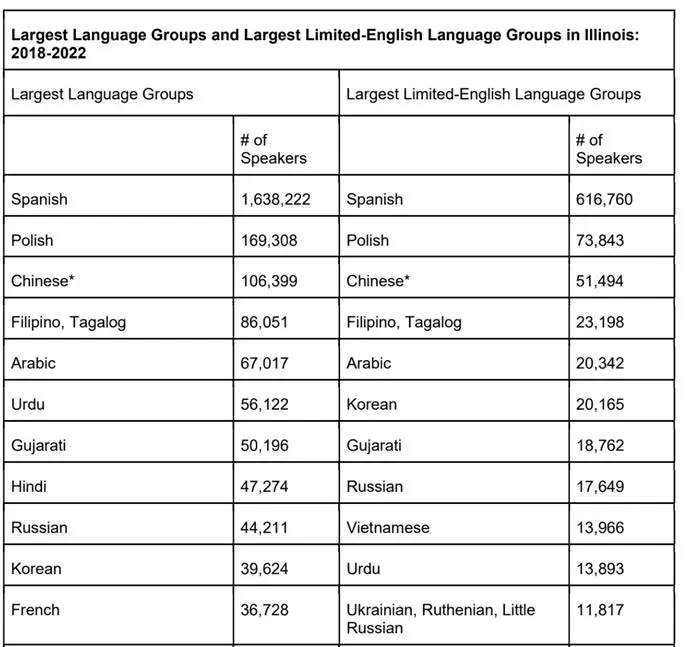
• The predominant language other than English in many Illinois counties may be Spanish, but closer examination of the most common non-English languages shows that immigrants and migrants come to Illinois from many places. For example, in Champaign County, the top language spoken in limited English households is Mandarin, and in Macon County, it is Tagalog. Additionally, in Cass and Knox counties, the second language is French/Haitian/Cajun. In Madison County, it’s Tagalog. In Cook, DuPage, and Kane counties, the second language category is Slavic. In Boone County,“other Asian Pacific Islander” is second to Spanish.
• A statewide map of persons who don’t speak English very well shows that the largest numbers of such persons are in the metro Chicago area. Nevertheless, significant numbers of up to 9 thousand are located in townships across the state and are often located near metro areas such as St. Louis, Springfield, Champaign, and Rock Island. There are also notable populations in relatively rural townships in counties such as Cass, Douglas, or Union.
• After years of decline, the number of Illinois residents who don’t speak English very well is on the rise. In examining ten years, from 2014 to 2023, this population fell by 79,000 persons between 2014 and 2019. But since a low of 1.0 million in 2019, the most recent data, for the year 2023, shows about 1,082,000
persons, for a gain of some 82,000.
Factor 2
Overview of Standard
Language Encounters Data Collection and Analysis assesses the frequency with which limited English proficient (LEP) individuals encounter ALPLM's services, programs, or activities.
The Illinois Language Equity and Access Act requires State agencies to conduct an individualized assessment as part of its Language Access Plan that considers the frequency with which persons with LEP come into contact with the services, programs, and activities provided by the agency. This analysis supports the ALPLM’s ability to identify language access needs and ensure meaningful access. In order to ensure that all ALPLM encounters with individuals with LEP across programs and services are collected in a comprehensive and ongoing manner, ALPLM will:
● Collect data on encounters with individuals with LEP that take place in person, by telephone, via email, and through online platforms.
● Track the languages encounters and types of language assistance services requested and/or provided during those encounters; and
● Conduct regular assessments and identify high-volume languages and the most frequently requested or needed language assistance services to ensure meaningful access that is accurate, timely, and effective at no cost to persons with LEP.
Current ALPLM Systems and Practices
The Agency tracks language requests monthly and keeps record of the following: The primary language of persons encountered when LEP services are requested at ticket counters.
Use of language assistance provided through contractual interpreters.
Factor 3
Overview of Standard
Services Provided to General Public and/or Prospective Limited English Proficient Users, assesses the nature and importance of the programs, activities, or services provided by ALPLM.
The Illinois Language Equity and Access Act requires State Agencies to implement an individualized assessment as part of their Language Access Plan that includes the
nature and importance of the services, programs, or activities provided by the State agency.
To ensure meaningful access to critical and urgent information and services, ALPLM will outline procedures for prioritizing language assistance for vital and urgent
information and activities. ALPLM will review all services and information and will prioritize language assistance for programs, activities, services, or information that, if
not understood by individuals using languages other than English, could have immediate and/or severe impacts.
Current ALPLM Systems and Practices
The ALPLM does not currently provide any vital or urgent services to the public. It would be beneficial to consult with professionals on our emergency preparedness protocols to ensure LEP persons’ safety during extreme weather or other emergencies.
Factor 4
Overview of Standard
Budget and Available Resources assesses the resources available to ALPLM currently, as well as the cost associated with providing the language assistance.
The Illinois Language Equity and Access Act requires State Agencies to review the resources available to the State Agency and the costs. It is best practice for the
budget for language access services to be based on programmatic needs and the top five languages prioritized for services. Additionally, a strategic practice is to
outline the costs associated with current language assistance services, as well as assess the level of resources, costs, and capacity to implement and support
additional language services over time. Based on the assessment of resources, ALPLM will identify efforts to support cost-savings and cost-sharing when/if needed.
Such efforts may include sharing resources with other departments and agencies and/or using technology to support the delivery of language assistance services.
Current ALPLM Systems and Practices
All costs associated with serving individuals who identify as LEP is allocated in the Guest Services Department budget and overseen by the Marketing and Guest
Services Director.
Section 3: Staffing and Coordination
Overview of Standards
The Illinois Language Equity and Access Act outlines the requirements for each State agency to designate a Language Access Coordinator who is responsible for
overseeing the development and implementation of the agency’s language access plan. The Language Access Coordinator Will support ongoing compliance by
partnering with ONA to ensure coordinated implementation and compliance with language access requirements.
To ensure adequate staffing to support the development, management, and oversight of the language access activities, and consistent with the Language Equity and Access Act’s directive to ensure adequate staff of bilingual employees, ALPLM will establish internal roles to implement its Language Access Plan. These roles include a Language Access Coordinator and may also include a Language Access Liaison within divisions or programs to support localized implementation and coordination of language assistance services, in alignment with national language access best practices.
The Illinois Language Equity and Access Act directs State agencies to incorporate language equity compliance provisions into their contracts with vendors, grantees,
and purchase of care entities, ensuring that these funded entities provide language assistance services to individuals with LEP.
ALPLM conducts programs and services in partnership with a wide network of grantees and funded entities. Therefore, ALPLM will take affirmative steps to ensure
those entities fulfill language access obligations to support monitoring and accountability.
Section 4: Language Assistance Services
ALPLM is committed to taking reasonable steps to ensure meaningful communication and access to information for ALPLM’s users with LEP. The Language Assistance Services section outlines the types of language assistance ALPLM currently provides, as well as the services ALPLM plans to provide to support meaningful communication and participation for individuals with LEP and who are limited English proficient. The language assistance services outlined in the Language Access Plan include oral interpretation services, virtual interpretation services, in-language assistance with multilingual staff, print and online translation services, and the development of other multilingual media content.
This section outlines the roles and responsibilities of ALPLM’s language access staff, including Language Access Coordinators and Language Access Liaisons, who are responsible for monitoring and ensuring the implementation of language assistance services according to the Language Access Plan across the agency.
4.1 Language Assistance Services Plan
1. Language Need Identification
Overview of Standard
The Language Access Plan requires State Agencies to develop clear policy and programmatic actions to ensure meaningful access. It is national language access
best practice for State Agencies to utilize language-need identification materials, such as printed multilingual I-Speak resource cards, to assist with the identification
of the languages requested by individuals with LEP. These tools support meaningful access by enabling individuals with LEP to indicate their language needs, consistent with State Agencies’ obligations to ensure accurate, timely, and effective communication.
Current ALPLM Systems and Practice
ALPLM posts notices regarding the language services it provides on the ALPLM website and at the visitor ticket counter of the museum through televisual monitors (display screens). The notices are displayed in various languages which are most frequently used by guests. If an individual self-identifies as an LEP at the museum ticket counter, translated map cards are provided, and guests are informed of translated scripts available for each of the permanent theater presentations. LEP guests generally visit the ALPLM via tour groups and are accompanied by an interpreter if they need language assistance services.
2. Hiring/Contracting Qualified Interpreters for In-Person Communication
Overview of Standard
The Illinois Language Equity and Access Act requires State Agencies to ensure individuals with LEP have access to competent, timely, and effective interpretation services when interacting with agency staff, programs, and services. Agencies are required to provide meaningful access. Using trained and qualified interpreters, in alignment with standards developed by ONA, supports State agency compliance and ensures meaningful access.
Current ALPLM Systems and Practices
The ALPLM utilizes the State of Illinois’ master contract (Propio) to obtain vendors to translate documents and for interpretive services to meet any language needs.
For interpretation, the individual will need to contact the museum to schedule their visit at a time convenient for the interpreter and visitor. It is the policy of the ALPLM to
allow an on-duty interpreter free admission to the museum. The ALPLM provides interpreter services when given advance notice to secure an interpreter through an outside entity. The Agency requests two weeks’ advance notice but strives to accommodate when the request is made with less than two weeks’ notice.
Records reflect that Language Assistance Services are most requested for American Sign Language (ASL) interpreters.
The ALPLM provides extended hours where sign language interpreters are available throughout the exhibits under the banner of “Abe for All.” Members from the community are also asked to provide feedback on how to provide better services.
If it is determined that requested information or reasonable accommodation is not available to LEP persons, staff will contact the Agency Language Access Coordinator for assistance and reporting.
3. Hiring/Contracting Qualified Interpreters for Virtual Communication (Over-the-Phone or Video)
Overview of Standard
The Illinois Language Equity and Access Act requires State Agencies to ensure individuals with LEP have access to competent, timely, and effective interpretation services when interacting with agency staff, programs, and services.
Current ALPLM Systems and Practices
When receiving telephone calls, the Agency utilizes the service “Nextalk” for those that are hearing impaired. This service is installed on two Guest Services computers to assist callers.
When receiving a phone call from an LEP individual, staff members obtain the person’s name and phone number. Depending on the language, bilingual staff or volunteers return the phone call. If no on-site interpretive services are available, the Agency will utilize a contractual translator.
4. Employing/ Utilizing Bilingual or Multilingual Staff
Overview of Standard
The Illinois Language Equity and Access Act require the Governor’s Office of New Americans, with the support of the Department of Human Services, and any other relevant agencies to set standards for adequate staffing of bilingual employees at State Agencies, including a methodology for monitoring implementation and updating the State Services Assurance Act and the Bilingual Employment Plan, based on the Language needs Assessment. While the Language Equity and Access Act specifically uses the term "bilingual staff", national language access best practices recognize and value the role of multilingual staff, highlighting the broad linguistic competencies of individuals who possess proficiency in more than two languages or multiple linguistic repertoires.
Current ALPLM Systems and Practices
The Human Resources manager will conduct an audit of employees to obtain a list of all bilingual staff. This list will be updated by the Human Resources manager as staff onboard and offboard. The LAC will hold a copy of this list for reporting purposes and coordination of resources.
5. Translation of Vital Documents and Online Content
Overview of Standard
The Illinois Language Equity and Access Act requires agencies to ensure that vital documents are translated accurately, completely, and in a timely manner by qualified translators.
Translation of vital documents will be in accordance with the Language Equity & Access Act and guidance issued by ONA.
In instances where LEP populations fall below these thresholds but still require meaningful access, agencies must provide written notice in the primary language of
the right to oral interpretation of the written material at no cost. Translation priorities should be guided by the most recent Language Needs Assessment Report and the demographic data of the agency’s service population.
Current ALPLM Systems and Practices
All policies and procedures needed to visit the museum should be translated and considered vital documents. The content in the galleries of the museum is accessible in multiple languages via the Lincoln Unlocked app. Language displayed in the app will match the selected language of the mobile device.
The ALPLM provides maps of the ALPLM campus and scripts of its shows in the following languages: French, German, Japanese, Mandarin and Spanish.
The ALPLM should provide signage using symbols instead of words when possible.
The ALPLM website https://presidentlincoln.illinois.gov is a vital document and is available in the six most common languages. It should be regularly audited to ensure that all text is presented in such a way that the automatic translation works. PDF attachments should be avoided.
Promotional items such as brochures, event flyers, and other mass produced documents are considered vital documents.
Where appropriate, the ALPLM utilizes the Department of Innovation and Technology’s document translation portal to translate documents from English.
The ALPLM utilizes the State of Illinois’ master contract to obtain vendors to translate documents and for interpretive services to meet any language needs.
6. Development and Distribution of Multilingual Content in Other Formats (Public Service Announcements, Radio Messaging, Social Media Information)
Overview of Standard
The Illinois Language Equity and Access Act requires State Agencies to take steps to ensure that digital content is accessible to individuals with LEP. All translations of
public-facing digital content will be completed in a manner that ensures accuracy, completeness, and timeliness, consistent with the Act’s requirement for competent translation services. The selection of languages for translation will be guided by current demographic data, the State’s Language Needs Assessment, and thresholds outlined in the Language Equity and Access Act.
Current ALPLM Systems and Practices
The agency does not currently develop digital content in languages other than English.
Section 5: Notification of Language Assistance Services
In addition to providing language assistance services, the Notification of Language Assistance Services section will outline how ALPLM can notify the public of language assistance services and provide information on how language assistance services can be requested. Such communication will assist individuals with LEP in understanding the services provided by ALPLM, which can increase public trust and confidence.
5.1 Notification of Language Assistance Services Plan
Overview of Standards
The Illinois Language Equity and Access Act requires State Agencies State Agencies ensure that the general public and individuals with LEP are informed of the availability of free interpretation and translation services and how to request them. To meet this requirement, ALPLM will provide multilingual public notices in various formats—both digital and physical—to promote broad public awareness. All notices will clearly explain how individuals can request interpretation or translation services and will be made available in the most frequently spoken languages identified through demographic analysis and the State’s Language Needs Assessment Report.
Current ALPLM Systems and Practices
LEP individuals should self-identify to receive translated documents or interpretation to their language of choice. ALPLM posts notices regarding the language services it
provides on the ALPLM website and at the visitor ticket counter of the museum through televisual monitors (display screens). The notices are displayed in various languages which are most frequently used by guests. If an individual self-identifies as an LEP at the museum ticket counter, translated map cards are provided, and guests are informed of translated scripts available for each of the permanent theater presentations.
Section 6: Language Access Training
ALPLM is committed to providing ongoing employment development and training on language access to maintain well-trained bilingual employees, general staff, and all staff who interact with or may interact with individuals with LEP receive ongoing professional development and training on language access policies, procedures, and responsibilities. This section outlines the type of language access training to provide all ALPLM personnel, as well as specific training responsibilities for bilingual or multilingual employees, frontline staff, and other personnel who may interact with individuals with LEP. This section also identifies the timing, frequency, and delivery methods for how training shall be implemented across the agency and its divisions.
6.1 Language Access Training Plan
Overview of Standards
The Illinois Language Equity and Access Act requires that State Agencies develop and implement an ongoing employee development and training strategy to maintain well-trained bilingual employees and general staff. This ensures the ALPLM is equipped to deliver effective language assistance services.
Current ALPLM Systems and Practices
Training will be provided to ALPLM staff yearly, with a particular focus on employees who are likely to encounter LEP individuals. This training will introduce staff to the Language Access Coordinator and will include information about the LAP and the related resources, policies and procedures. All managers and senior level personnel
at the Agency shall be trained so that they understand the content of the LAP and the decision-making process for interacting with LEP individuals. All staff that interact
with the public directly in Guest Services will be trained in locating the documents and reporting interactions with LEP guests.
Section 7: Concern Resolution Process
The Concern Resolution Process Section of the Language Access Plan highlights the need for allowing public feedback on the quality, accessibility and effectiveness of
language assistance services to address any concerns that arise. This section outlines how ALPLM will develop and make publicly available a multilingual concern resolution form, collect and log complaints submitted by individuals with LEP and others and promptly investigate and address each concern in a timely manner. Additionally, this section describes how the ALPLM will track the resolution status of complaints to ensure transparency and accountability and coordinate with the ONA when appropriate to support compliance and continuous improvement.
Overview of Standards
The Illinois Language Equity and Access Act requires State Agencies to establish and make publicly available a process for individuals with limited English proficiency (LEP) and members of the public to submit concerns related to access to language assistance services. Section 15(b)(5) of the Act requires each State agency to develop an internal complaint and review process specific to the provision of language assistance services. Complaints that are not resolved in a timely or satisfactory manner may be referred to the Governor’s Office of New Americans for further review, per Section 30(c) of the Act.
Current ALPLM Systems and Practices
Per the Language Equity and Access Act (15 ILCS 56):
• ONA shall report “aggregate data on the number of complaints filed and the status or resolution of the complaints.” In order for ONA to create this report, agencies must submit relevant data regarding complaints at the end of each fiscal year.
• “The Governor's Office of New Americans shall attempt to resolve a language access complaint received by a State agency if the agency does not resolve the complaint in a timely manner or the resolution is inadequate. Upon referral of a complaint, the Governor's Office of New Americans may engage in informal processes, including mediation, conference, and conciliation, to resolve the complaint.”
In order to ensure that both agencies and the Governor’s Office of New Americans (ONA) are adequately tracking, reporting, elevating, and addressing complaints, ALL
agency complaint processes must include the following:
Requirement #1: Agency Tracking + Reporting
• Language Access Coordinators MUST have a centralized process to track received complaints, time since the complaint was received, and the status of the complaint. This could be an excel sheet that where all new complaints submitted to an online form are entered that includes columns to track the time since submission, latest updates, and status. Click here to see an excel template for tracking complaints. Complaint status should be evaluated in the following phases:
• Received: The complaint is being processed by the agency. No outreach has been made.
• Pending: The agency is actively working to address the complaint and gathering information from the parties involved.
• Resolved: The complaint has been resolved and no further action is required.
• Resolved with a recommendation: The complaint has been resolved AND the agency has made a recommendation to improve process or protocol to proactively address the issue.
• Tracking should be updated to reflect all complaints received from the beginning on FY26 (July 1st, 2025), when possible, OR, in the event no complaint process was previously established, upon implementation of this process.
• Language Access Coordinators MUST report the number of complaints filed in a fiscal year and the status of those complaints as of the last day of the fiscal
year (June 30th) to ONA in annual data reporting requests following the conclusion of the previous fiscal year. The first data reporting request will occur after June 30th, 2026.
Requirement #1: ONA Tracking + Elevation
• Language Access Coordinators MUST provide updates to the Office of New Americans to ensure all complaints are addressed in a timely fashion:
• ONA should be notified upon receipt of a language access complaint by completing the ONA Language Access Complaint Notification Form
• ONA will send individual monthly reports through GOV.NewAmericans@illinois.gov to Language Access Coordinators at agencies with a list of outstanding complaints from that agency being tracked. At that time, Language Access Coordinators should provide an update as to which outstanding complaints, if any, have been resolved. Additionally, Language Access Coordinators should indicate if any additional support from ONA would be beneficial in resolving the complaint.
• In the event that a complaint remains unresolved for over 30 days, ONA may engage in additional follow-up with a Language Access Coordinator to offer appropriate support and, if needed, assist in the resolution of the complaint.
• NOTE: ONA will assess all attempted resolution strategies that the agency has utilized as well as the nature of the complaint to determine whether the complaint is being resolved in a “timely manner.” This may be different for all complaints.
• Once a complaint is resolved, agencies must include information to the individual who submitted the complaint about the option to elevate their complaint to the Governor’s Office of New Americans if they feel the resolution is inadequate by completing the ONA Language Access Complaint Elevation Form.
NOTE: This form will be hosted publicly on the ONA Website in the Language Access sub-section, which is linked above. This guidance will be updated with a direct link ASAP.
• In order for a complaint to be supported by ONA through this process, it MUST have been submitted to the original agency first and gone through a resolution process supported by the Language Access Coordinator. To confirm this, if the Office of New Americans receives a submission of the ONA Language Access Complaint Elevation Form,
submission details will be cross referenced with complaints that have already been sent to ONA by language access coordinators per #1.
• In the event an existing agency-level complaint is identified, ONA will notify the relevant Language Access Coordinator to coordinate an appropriate resolution.
• In the event an existing agency-level complaint is NOT identified, ONA will notify the relevant Language Access Coordinator to confirm whether the complaint has been submitted to the agency.
• If an agency-level complaint has been submitted, ONA will continue coordination with the Language Access Coordinator per step (i).
• If an agency-level complaint has NOT been submitted, ONA will refer the individual who submitted the complaint to the agency-level complaint process.
Section 8: Monitoring, Evaluation, and Reporting
The Monitoring, Evaluation, and Reporting section of the Language Access Plan outlines the implementation and procedures ALPLM will implement to assess compliance with the Illinois Equity and Access Act and evaluate the effectiveness of this Language Access Plan and its action items. This section will outline current practices and procedures for monitoring and collecting language access data, analyzing language use and language assistance needs, procedures for collecting and participating in community engagement/community feedback sessions to gather input on improvements to the Language Access Plan and language assistance service, and evaluating the quality of language assistance services offered by ALPLM.
8.1 Monitoring, Evaluation, and Reporting Plan
Overview of Standard
In accordance with the Illinois Language Equity and Access Act, ALPLM will coordinate with the Governor’s Office of New Americans to review and monitor the implementation of its Language Access Plan and ensure ongoing compliance with the Act.
ALPLM will conduct an individualized assessment of language assistance needs and patterns of language use on an ongoing basis and incorporate updated data and performance metrics into each new iteration of the Language Access Plan, as required under Section 25(d)(3). The agency will use this information to evaluate the effectiveness of current policies and practices and to inform continuous improvement of language access services.
The plan will include the ongoing review of statewide and agency-specific data on limited English proficient (LEP) populations, including demographic shifts and the identification of new or emerging language needs, as outlined in the State’s Language Needs Assessment Report. The monitoring and evaluation plan will also track progress on the implementation of Language Access Plan goals, review expenditures related to language assistance services and assess whether projected changes in costs require budget adjustments or modifications to service delivery methods. Data will be collected and reviewed using the following methods:
Current ALPLM Systems and Practices
The ALPLM Language Access Coordinators will report to ONA in annual data reporting requests following the conclusion of the previous fiscal year. These numbers will include the number of requests for language assistance requested broken down by language requested. There will also be a report of how many complaints were filed and length of time required to address each complaint. ALPLM will also track the number of promotional materials distributed each year broken down by language selected.
Section 9: Resources
● Illinois Statewide Coordination Plan Draft (Link)
● Illinois Language Access Toolkit
Section 10: Appendix
Appendix 1: Factor 1 American Community Survey Demographic data